
Adapt Team
Use cases
Sales
Turn every sales objection into a reusable play

The problem: objection knowledge does not compoundWhat Adapt doesAn objection playbook that maintains itselfWhat you need connectedWhy this needs an agent, not a reportFAQHow do you build a sales objection playbook automatically?What counts as a sales objection?Can AI prepare a rep for a specific call?Will it make things up?Does this replace sales enablement?
Every sales team has an objection-handling doc. Almost every one of them is out of date.
It gets written once, usually by whoever was closing the most deals that quarter, and then reality moves. A competitor changes its pricing. A new build-versus-buy argument shows up because a prospect's engineering team now has an in-house model. Somebody on the team finds a reframe that lands every time, uses it on nine calls, and never writes it down. The doc stays where it was.
Meanwhile the raw material is sitting right there. Every objection anyone has ever raised, and every response that did or did not work, is in your call recordings. It just is not in a form anyone can use before the next call.
The problem: objection knowledge does not compound
The knowledge exists. It simply never accumulates anywhere useful.
- It lives in individual heads. The rep who handled the pricing pushback well knows how. Nobody else does, unless they happened to be on the call.
- Recordings are searchable but not usable. You can find a call. You cannot easily find "every time a prospect said they could build this in-house, and what we said back."
- The doc rots the moment it ships. A static playbook cannot keep up with a market that changes weekly.
- Call prep starts from zero. The rep opens the CRM, skims some notes, maybe skims a transcript, and walks in without the accumulated pattern from the last thirty calls.
- Proof gets separated from the claim. Knowing the reframe is half of it. Knowing which customer story to have ready when you use it is the other half.
The net effect: a team relearns the same five objections indefinitely.
What Adapt does
This runs as an automation rather than a question. When a call ends, a webhook fires and Adapt processes the transcript without anyone asking.
- Fetches the transcript. It pulls the recording transcript from the meeting recorder as soon as the call ends.
- Captures the participants and the substance. For each external attendee it records name, title, company, the pains they raised, and the agreed next steps.
- Mines the objections. It reads the transcript for any statement of resistance, doubt, risk, or deprioritization from the prospect side: price and budget pushback, build-versus-buy, security concerns, timing, incumbent tooling.
- Captures how each one was handled. The response, and whether it moved the conversation.
- Stays grounded. The instruction in the workflow is explicit: ground everything in the transcript, never invent a quote or a tactic. A fabricated objection-handling play is worse than none.
- Writes it back where the team works. The output lands in Slack and in the CRM, so the next person to touch the account inherits it.
Then the compounding part. When the next call gets booked, Adapt produces a prep brief that draws on everything it has already learned: business context and the pain to uncover, then the likely objections for this specific prospect, each with the play that has worked, why it works, and the proof to have ready.
Because the corpus grows with every call, the briefs get better on their own. A brief will cite the exact framing that flipped a named account on the same objection two weeks earlier. Nobody wrote that down. The workflow captured it.
An objection playbook that maintains itself
Another way to describe this: it is a living sales playbook whose source of truth is what actually happened on calls, not what someone believed at the time they wrote the doc.
The manual equivalent would be a sales enablement person listening to every recorded call, tagging objections, tracking which responses correlated with progression, and rewriting the playbook weekly. Teams do not do this because it is a full-time job. Which is precisely why it is a good candidate for an agent.
What you need connected
- A call recorder with transcripts. Grain in this demo. Gong, Fireflies, Zoom, and Fathom expose the same thing.
- Slack, for delivery of briefs and post-call recaps.
- Your CRM. HubSpot in this demo, for writing the context back onto the deal and the contacts.
- A webhook, so the workflow fires when a call ends rather than waiting to be asked.
Why this needs an agent, not a report
A recording tool can transcribe and even summarize a single call. What it cannot do is reason across every call you have ever recorded, notice that the same objection has now appeared eleven times, identify which of the four responses used correlated with the deal moving forward, and then hand that to a rep as prep for a specific upcoming meeting with a specific company.
That requires reading across calls, joining to CRM state, and making a judgment about relevance. It is also the difference between a summary and a playbook.
FAQ
How do you build a sales objection playbook automatically?
Process every call transcript as it ends. Extract the objections the prospect raised, the response that was given, and whether the deal advanced. Store those as reusable plays, then surface the relevant ones during prep for the next call. The playbook is a byproduct of calls you were already recording.
What counts as a sales objection?
Any statement of resistance, doubt, risk, or deprioritization from the buyer side. That includes price and budget, build-versus-buy, security and compliance, timing, incumbent tools, and lack of internal sponsorship. Detecting them consistently is what makes the pattern visible.
Can AI prepare a rep for a specific call?
Yes. A prep brief can combine public research on the account, the CRM history, the pains raised on previous calls, and the objections most likely to come up, each paired with the response that has worked before and the proof point to have ready.
Will it make things up?
Not if the workflow is built correctly. The instruction here is to ground every objection and every play in the actual transcript and never invent a quote or a tactic. A playbook that hallucinates a customer quote is a liability, so the grounding rule is not optional.
Does this replace sales enablement?
No. It removes the transcription and tagging work that makes maintaining a playbook impractical, so enablement can spend its time on coaching and positioning instead of on listening to recordings with a notepad.
Want your calls turned into a playbook that maintains itself? Book a session with an Adapt engineer.
More use cases
1:52
Getting started4 min read
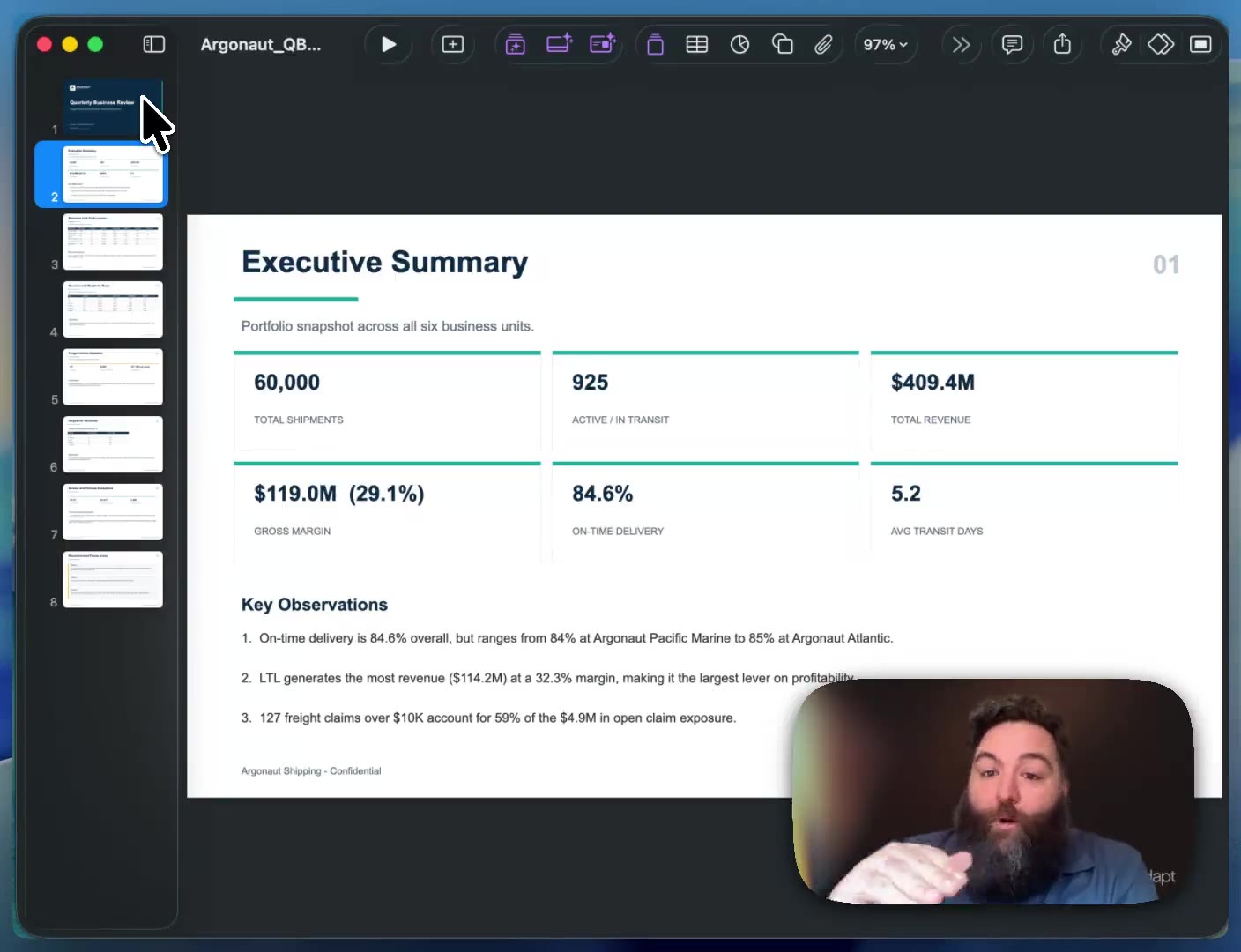
Upload one file and get a finished QBR deck back
No integrations, no setup, no connectors. Drag in a raw export, describe the deck you need, and get a filled quarterly business review built from your own numbers.
2:58
Marketing5 min read
Go from ad idea to finished social video in one thread
A rough concept, a few rounds of feedback, and a rendered social video with real performance data in it. No brief, no agency, no handoff between five tools.
1:47
Customer Success5 min read
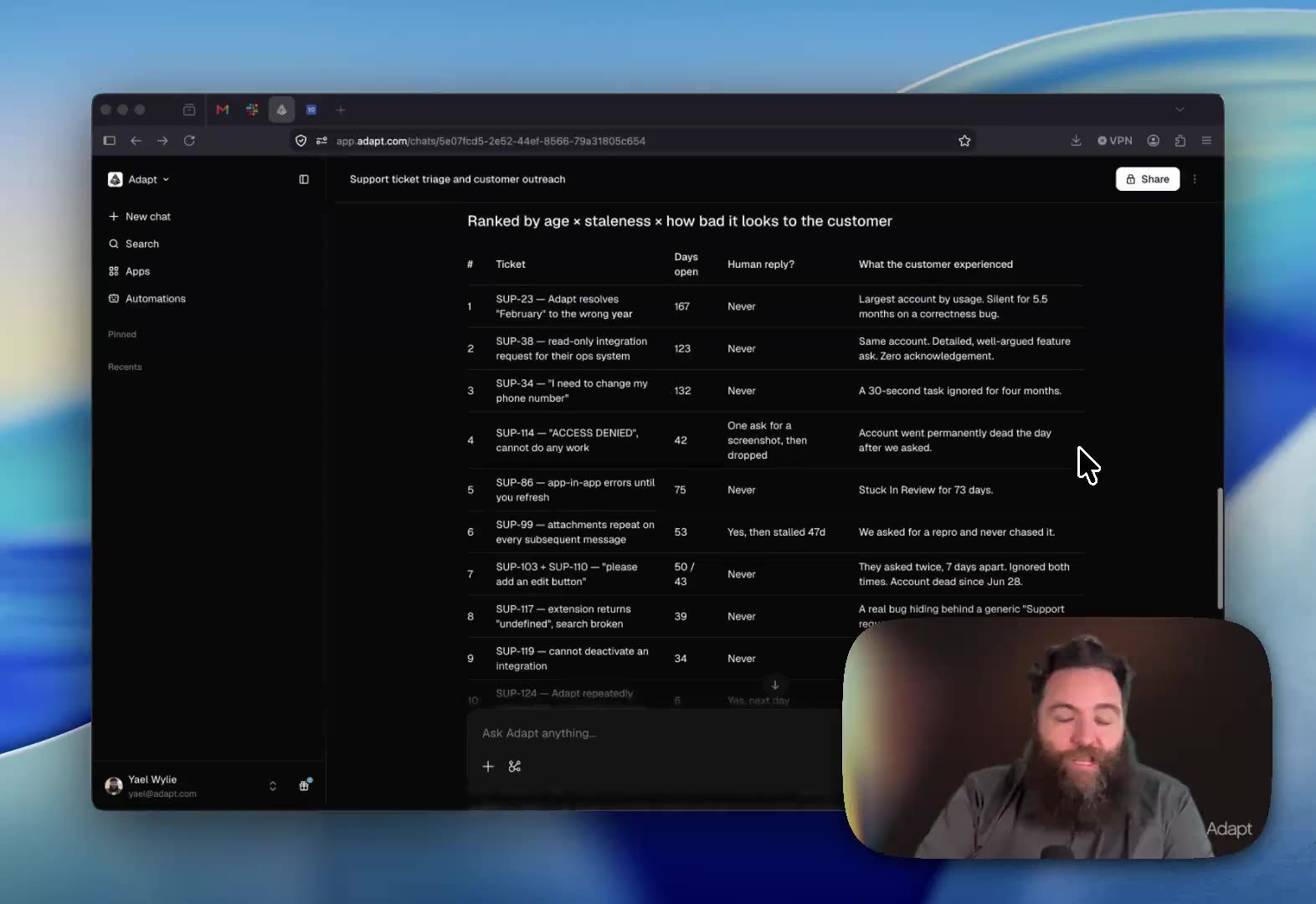
Triage a support queue and find the tickets nobody filed
Your support backlog is only half the problem. The other half is sitting in shared Slack channels as messages nobody answered. Here is how an AI coworker ranks both, and drafts the replies.

Make your company
instantly AI native.
Bring us a priority or workflow. We’ll show you how Adapt can put it to work across your company.