
Adapt Team
Use cases
Marketing
Go from ad idea to finished social video in one thread

The problem: creative production is mostly coordinationWhat Adapt doesCreative iteration without the handoff taxWhat you need connectedWhy this needs a computer, not just a modelFAQCan AI make a finished ad video, not just the script?How do you keep AI-generated creative on brand?Can the ad include live performance data?How long does it take to produce one ad this way?Does this replace designers?
Making one social ad is a surprisingly long chain. Somebody has an idea. Somebody writes a brief. A designer builds styleframes. Someone reviews them. A motion person animates it. Someone notices the data in the ad is three weeks old and has to go pull it again. Then it gets resized for each platform.
Every link in that chain is a handoff, and every handoff is a day. The cost is not any single step. It is that the idea has to survive a week of coordination before anyone can see whether it was any good.
This use case compresses the chain into a conversation.
The problem: creative production is mostly coordination
The making is not usually the bottleneck. The moving between people and tools is.
- The brief is a translation layer. The person with the idea writes it down for someone who then interprets it, which introduces drift and takes time.
- Data in creative goes stale. Any ad that quotes real numbers needs those numbers re-pulled at render time, and that means a second person and a second system.
- Brand consistency depends on memory. Fonts, colors, logo treatment, and the outro plate are all rules somebody has to remember and someone else has to check.
- Iteration is expensive. Changing the runtime from 90 seconds to 40 sounds trivial and is not, once a storyboard exists in someone else's file.
- Platform variants multiply the work. The same idea has to exist at multiple aspect ratios for different placements.
The result: teams make fewer ads than they want to, and test less than they should.
What Adapt does
The demo starts with a concept written the way a marketer would actually say it out loud:
Let's create an ad. I want something that showcases how Adapt is different, something that showcases its use of the sandbox. Adapt is different because it can use a computer along with all of the connections and integrations to run extremely complex reports. I want to show how fast it is by showing someone trying to beat the clock building an ad using Adapt vs using traditional methods.
From there it is a working session, not a handoff:
- It proposes a treatment. A side-by-side traditional-versus-Adapt timeline, with production notes.
- It applies your brand rules automatically. The agent loads the org's saved skills for demo video, brand motion, brand guidelines, and social video prep. Typography, palette, logo lockup, and the closing plate come from those rather than from a designer remembering them.
- It takes direction. "Make sure it won't take more than 90 seconds." "This will be shown on social media, so optimize for that." The plan updates in place.
- It surfaces its own tradeoffs. Before rendering, it flags the two brand rules the concept would need to bend and asks for approval, rather than quietly breaking them or quietly refusing.
- It pulls live data into the creative. The ad contains a real paid-performance table across Reddit, LinkedIn, and Meta with impressions and click-through rates, queried at build time from the ad platforms rather than pasted from a stale screenshot.
- It renders in its own sandbox. The agent has a computer. It generates styleframes, writes them to disk, renders the composition, and then looks at its own output and critiques it.
- It produces the finished asset. A vertical social cut with a title card, the data sequence, a race-clock device, and the standard brand close.
The whole loop, concept to rendered video, happens in one thread with one person in it.
Creative iteration without the handoff tax
Another way to frame this: the value is not that an AI made a video. Plenty of tools make videos. The value is that the person with the idea never had to hand it to anyone, and the data in the finished ad is current as of the render.
That changes what you can test. When a variant costs a conversation instead of a week, running five concepts against each other stops being a quarterly project.
What you need connected
- Your ad platforms, if the creative should contain real performance data. Reddit Ads, LinkedIn Ads, Meta, and Google Ads.
- Brand guidelines saved as a skill, so typography, color, logo usage, and the outro plate are applied consistently instead of remembered.
- Somewhere to publish, if you want the workflow to continue past the render. Typefully, Slack, or your ad manager.
- Nothing else. Rendering happens in the agent's own sandbox, so there is no design tool to license or seat to provision.
Why this needs a computer, not just a model
Most AI writing tools can produce a script. Producing the actual asset is a different problem: it requires running code, installing a rendering toolchain, generating frames, writing files, and inspecting the result.
That is the distinction that matters here. An agent with a sandbox can do the production work, not just describe it. And because the same agent also holds the integrations, it can put live numbers from your ad accounts into the frame it is rendering, which is the part no standalone creative tool can do.
FAQ
Can AI make a finished ad video, not just the script?
Yes, if the agent has its own compute. Script generation only needs a model. Rendering needs a machine that can run a toolchain, generate frames, and write files. An agent with a sandbox can do both, and can review its own output before handing it over.
How do you keep AI-generated creative on brand?
Save the brand rules as a reusable skill: typography, palette, logo lockup, spacing, and any immutable assets like a closing plate. The agent applies them on every render instead of relying on someone to remember and someone else to check.
Can the ad include live performance data?
Yes. Because the agent is connected to the ad platforms, it can query impressions, click-through rates, and spend at render time and place the current numbers into the creative, rather than someone pasting a screenshot that goes stale.
How long does it take to produce one ad this way?
The demo goes from a one-paragraph concept to rendered styleframes and a finished cut within a single working session. The saving is not the render time, it is removing the brief, the handoffs, and the wait between them.
Does this replace designers?
No. It removes the mechanical parts of production and shortens the loop between an idea and something you can look at. Judgment about what is worth making, and whether the result is any good, is still the human's job, which is why the workflow pauses for approval before bending a brand rule.
Want to see this run on your brand and your ad accounts? Book a session with an Adapt engineer.
More use cases
1:52
Getting started4 min read
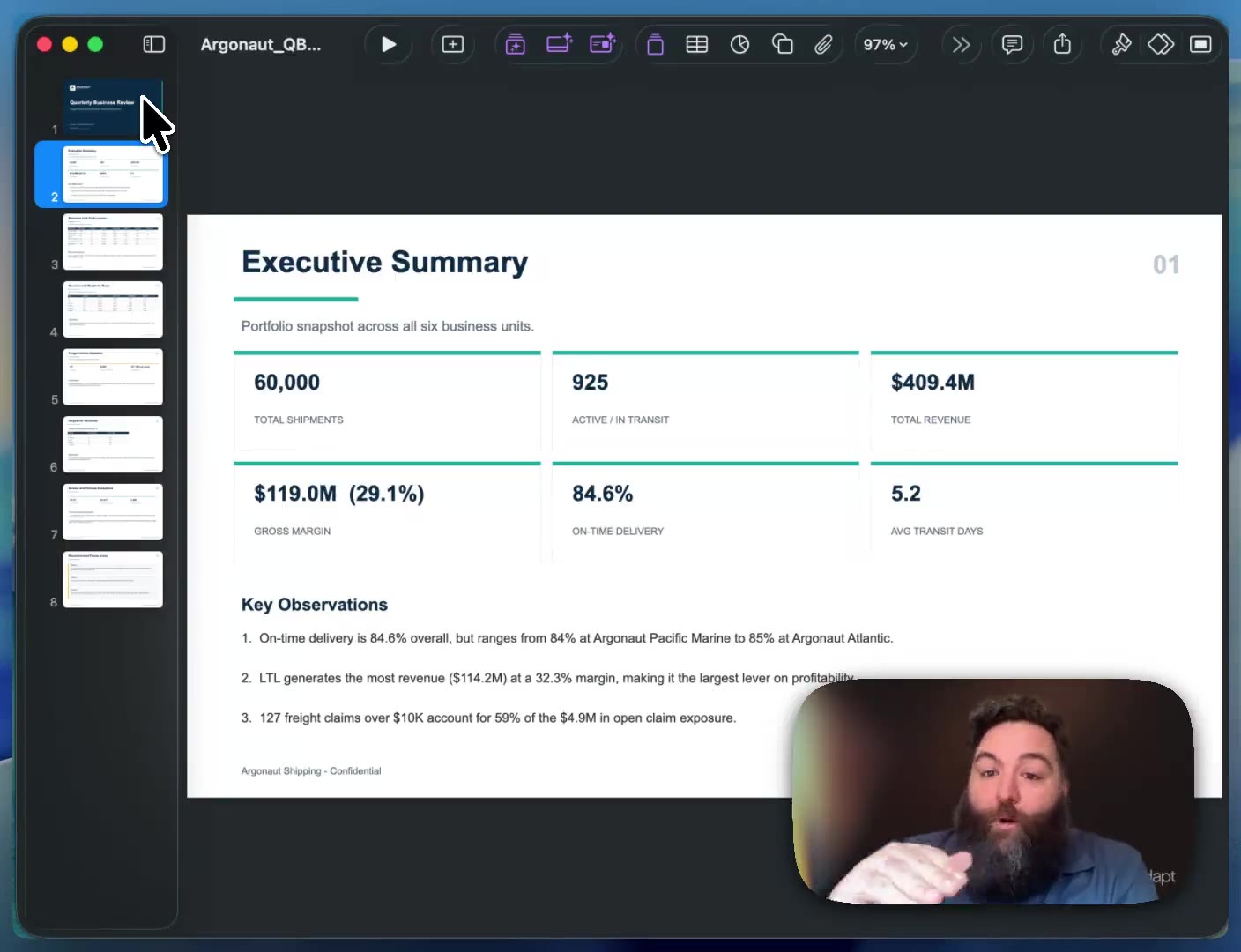
Upload one file and get a finished QBR deck back
No integrations, no setup, no connectors. Drag in a raw export, describe the deck you need, and get a filled quarterly business review built from your own numbers.
1:47
Customer Success5 min read
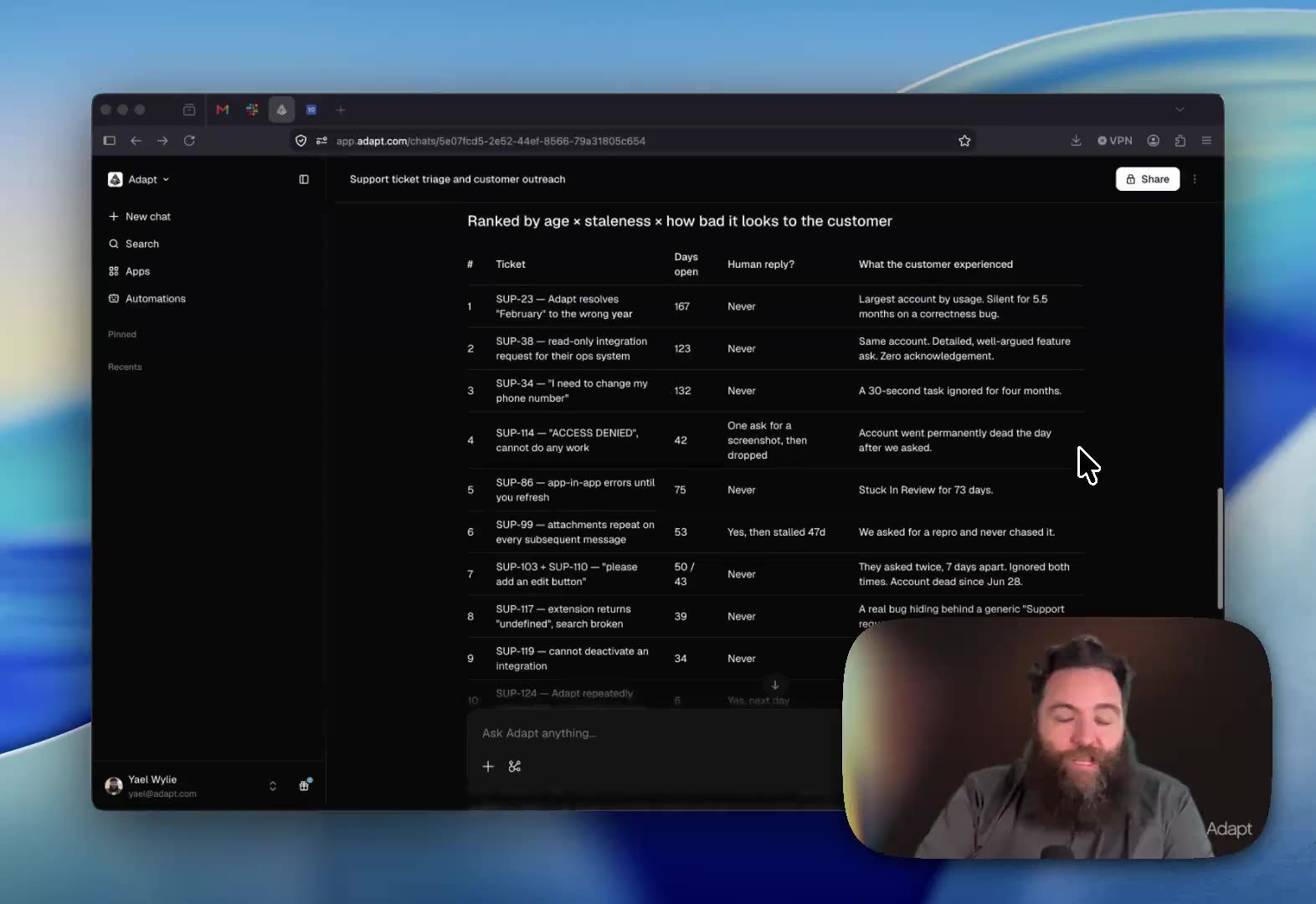
Triage a support queue and find the tickets nobody filed
Your support backlog is only half the problem. The other half is sitting in shared Slack channels as messages nobody answered. Here is how an AI coworker ranks both, and drafts the replies.
1:03
Leadership5 min read
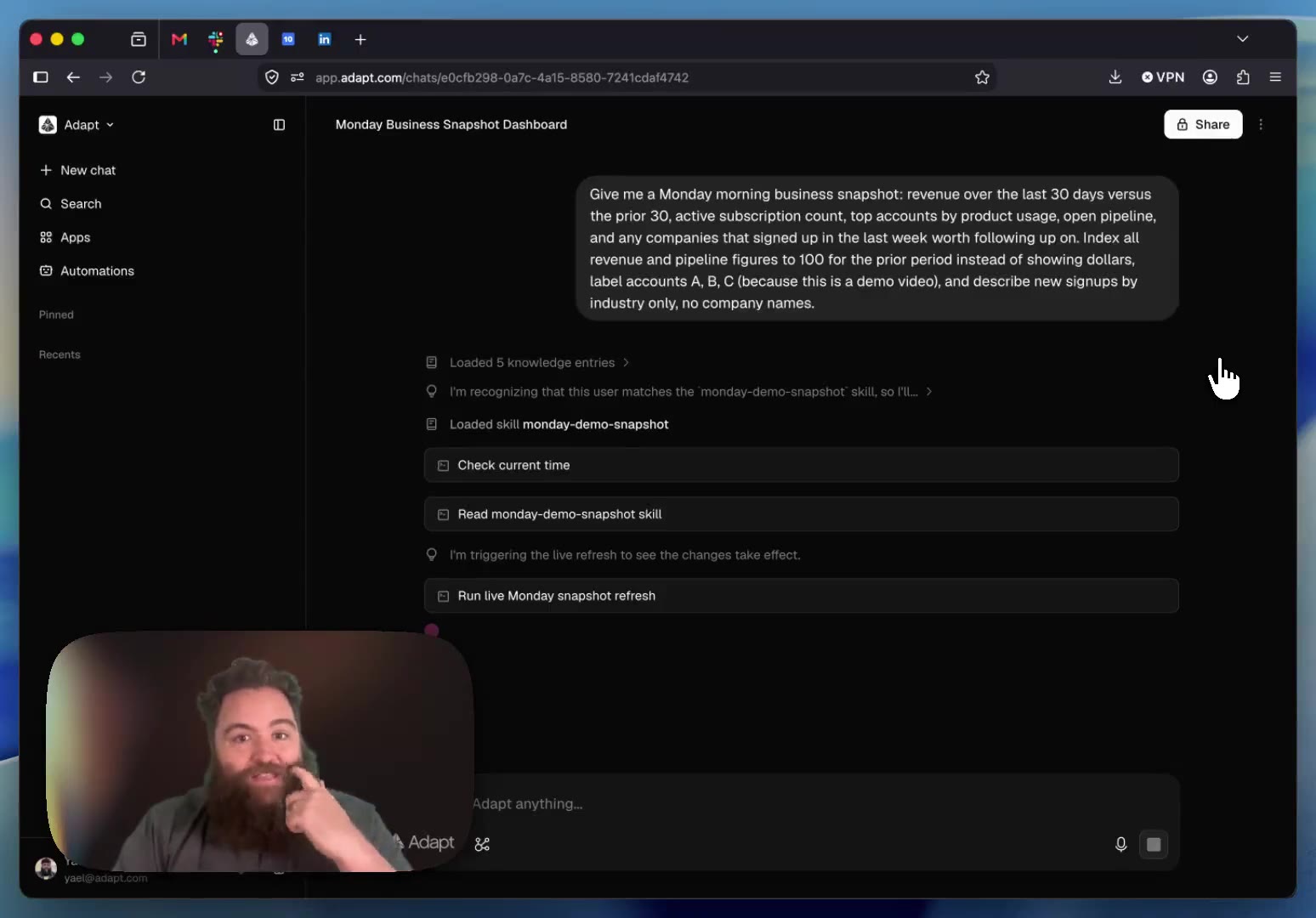
Get a Monday morning business snapshot in one prompt
Revenue, subscriptions, top accounts, open pipeline, and last week's signups. One question on Monday morning instead of five dashboards and a spreadsheet.

Make your company
instantly AI native.
Bring us a priority or workflow. We’ll show you how Adapt can put it to work across your company.