
Adapt Team
Use cases
Operations
Give every new hire a day-one onboarding buddy

The problem: onboarding docs are always a little bit wrongWhat Adapt doesAn onboarding buddy that never gets tired of the questionWhat you need connectedWhy a wiki does not solve thisFAQHow can AI speed up employee onboarding?What questions should an onboarding assistant handle?How is this different from an onboarding wiki?Does it work outside engineering?Is company information safe?
The first week at a new company is mostly a scavenger hunt. Which tools do we use for what. How do I get access. Where does the code live. Who do I ask about billing. What does this internal acronym mean. Is there a doc for this, and is that doc still true.
None of these are hard questions. Every one of them has an answer that somebody at the company already knows. The cost is not difficulty, it is friction: the new hire waits, or interrupts someone, or guesses. Multiply by every question in a first week and you get the thing everyone accepts as normal, which is that a new person is not really productive for a month.
The awkward part is that the more senior the person answering, the more expensive the interruption, and the more likely the new hire hesitates to ask.
The problem: onboarding docs are always a little bit wrong
Most companies have onboarding documentation. Very few have onboarding documentation you would bet a new hire's first week on.
- Docs go stale silently. The tooling list was accurate when it was written. Then the team moved off one tool, added two others, and nobody updated the page.
- The real answer is spread across systems. Part of it is in a README, part in a Notion page, part in a Slack thread from four months ago, and part exists only in one person's head.
- New hires do not know what to search for. You cannot find the doc about the deploy process if you do not yet know the deploy process has a name.
- Asking has a social cost. People ration their questions to avoid looking slow, which is exactly the wrong incentive in week one.
- The answers are not personal. "Which permissions do I need" depends on the role. A static doc answers for everyone and therefore for no one.
What Adapt does
The demo is a new hire asking, in plain language, the questions they would otherwise have queued up for a teammate. Adapt answers from what the company actually has, not from a generic template.
- Reads the real sources. Internal docs and repos, the engineering handbook, past Slack discussion, and the org's saved knowledge.
- Answers the tooling question concretely. Which tools the company runs, what each is for, and which ones this person will need. In the demo that is a specific stack: source control, cloud, issue tracking, secrets management, deploys, error tracking, product analytics, design, payments, email, model providers, and chat.
- Explains access, not just names. Where shared credentials live, which vault to use, and how local environment configuration is handled, so the new hire can actually get set up rather than just learning that a tool exists.
- Answers "who do I ask." It produces a who-owns-what view, so the next question goes to the right person the first time instead of to a general channel.
- Stays current by construction. Because it reads the live sources rather than a snapshot, the answer reflects what the company is doing now. When the repo changes, the answer changes.
The whole thing happens in Slack, which is where a new hire already is on day one, and where they would have asked the question anyway.
An onboarding buddy that never gets tired of the question
Put differently: this is the teammate who patiently answers the twelfth basic question of the morning with the same care as the first, and who is available at 9pm when the new hire is setting up their laptop.
That matters more than it sounds. The reason ramp is slow is rarely that the material is hard. It is that the feedback loop is long. When the answer arrives in five seconds instead of five hours, a new hire can actually work through setup in one sitting.
It also protects the team. The person who has historically been the human knowledge hub, the one everyone DMs, gets their week back.
What you need connected
- Your documentation. Notion, Confluence, Google Docs, or Markdown in a repo.
- Your code host, if engineering onboarding is in scope. GitHub or GitLab.
- Slack, both as the interface and as a source of institutional history.
- Org knowledge, for the things that are true but written down nowhere, like naming conventions or who owns which vendor relationship.
Why a wiki does not solve this
A wiki is a place to put answers. It is not a place to get them, because getting them requires knowing the question, the vocabulary, and where somebody filed it.
Search does not fix that either. Search matches words; a new hire does not yet have the words. What actually works is being able to ask a vague, badly-formed question in your own language and get a specific answer, then ask a follow-up. That is a conversation, and it needs something that has read everything and can reason about which part is relevant to you specifically.
FAQ
How can AI speed up employee onboarding?
By answering the routine questions instantly and from live sources. Tooling, access, conventions, and ownership account for most of a new hire's first-week questions. An AI coworker connected to your docs, repos, and Slack can answer them in seconds without pulling a teammate away from their work.
What questions should an onboarding assistant handle?
Which tools the company uses and why, how to get access to each, where credentials and environment configuration live, how deploys or approvals work, what internal terms mean, and who owns which area.
How is this different from an onboarding wiki?
A wiki requires the new hire to know what to search for and requires someone to keep it current. An AI assistant reads the underlying systems directly, so it answers vague questions in the person's own words and stays accurate as the sources change.
Does it work outside engineering?
Yes. The pattern is identical for sales, finance, support, and operations. The only thing that changes is which systems it reads and which access questions matter.
Is company information safe?
The agent respects the permissions of the person asking and the access policies set by admins. A new hire sees what their role is entitled to see and nothing more.
Want a day-one buddy for your next hire? Book a session with an Adapt engineer.
More use cases
1:52
Getting started4 min read
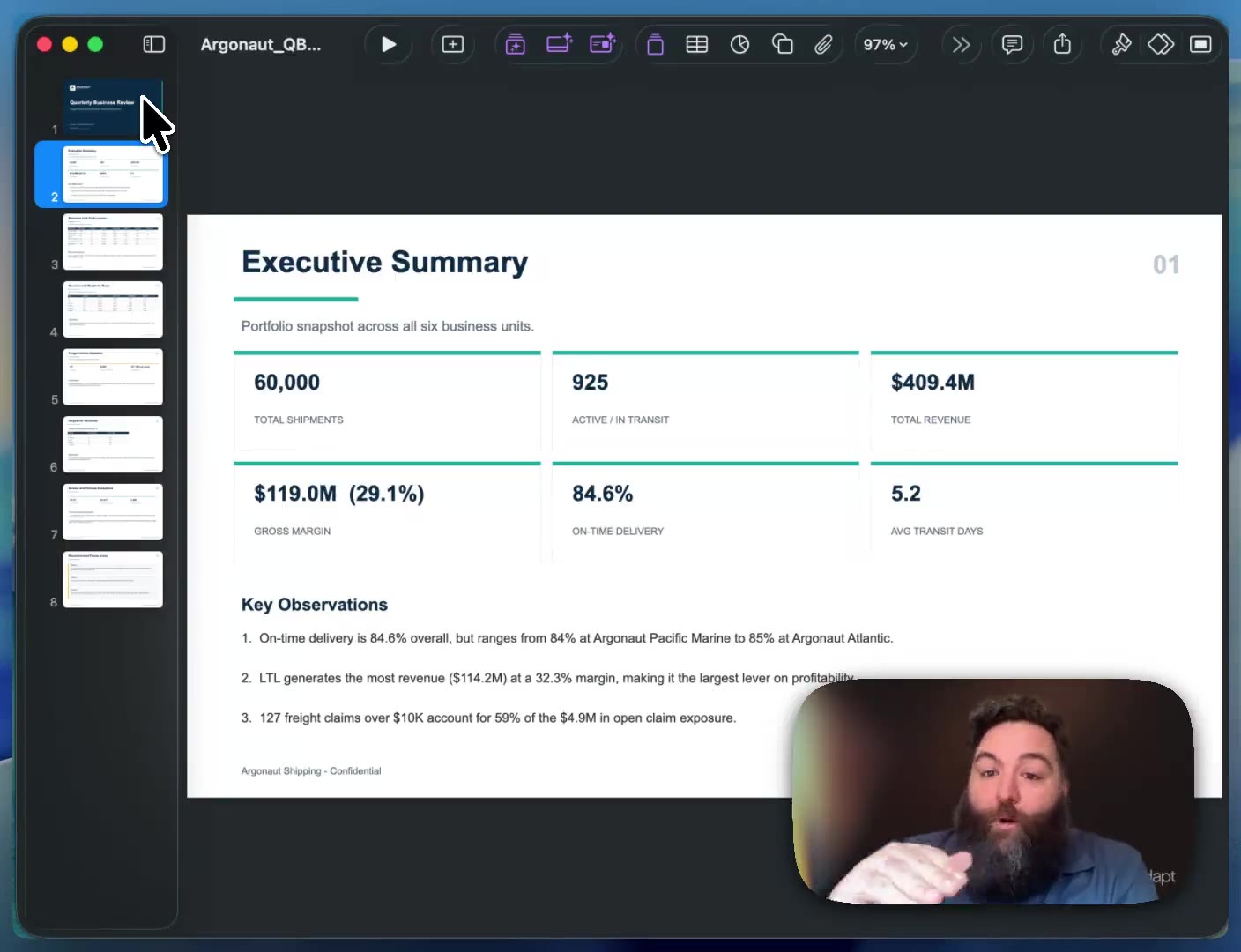
Upload one file and get a finished QBR deck back
No integrations, no setup, no connectors. Drag in a raw export, describe the deck you need, and get a filled quarterly business review built from your own numbers.
2:58
Marketing5 min read
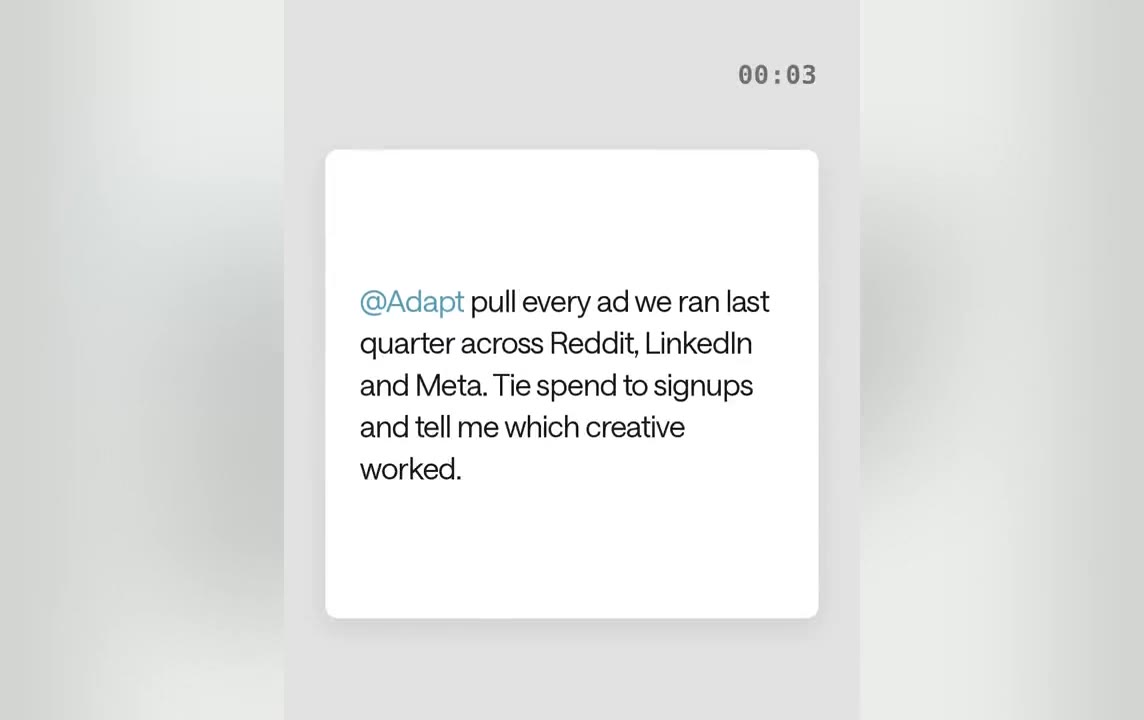
Go from ad idea to finished social video in one thread
A rough concept, a few rounds of feedback, and a rendered social video with real performance data in it. No brief, no agency, no handoff between five tools.
1:47
Customer Success5 min read
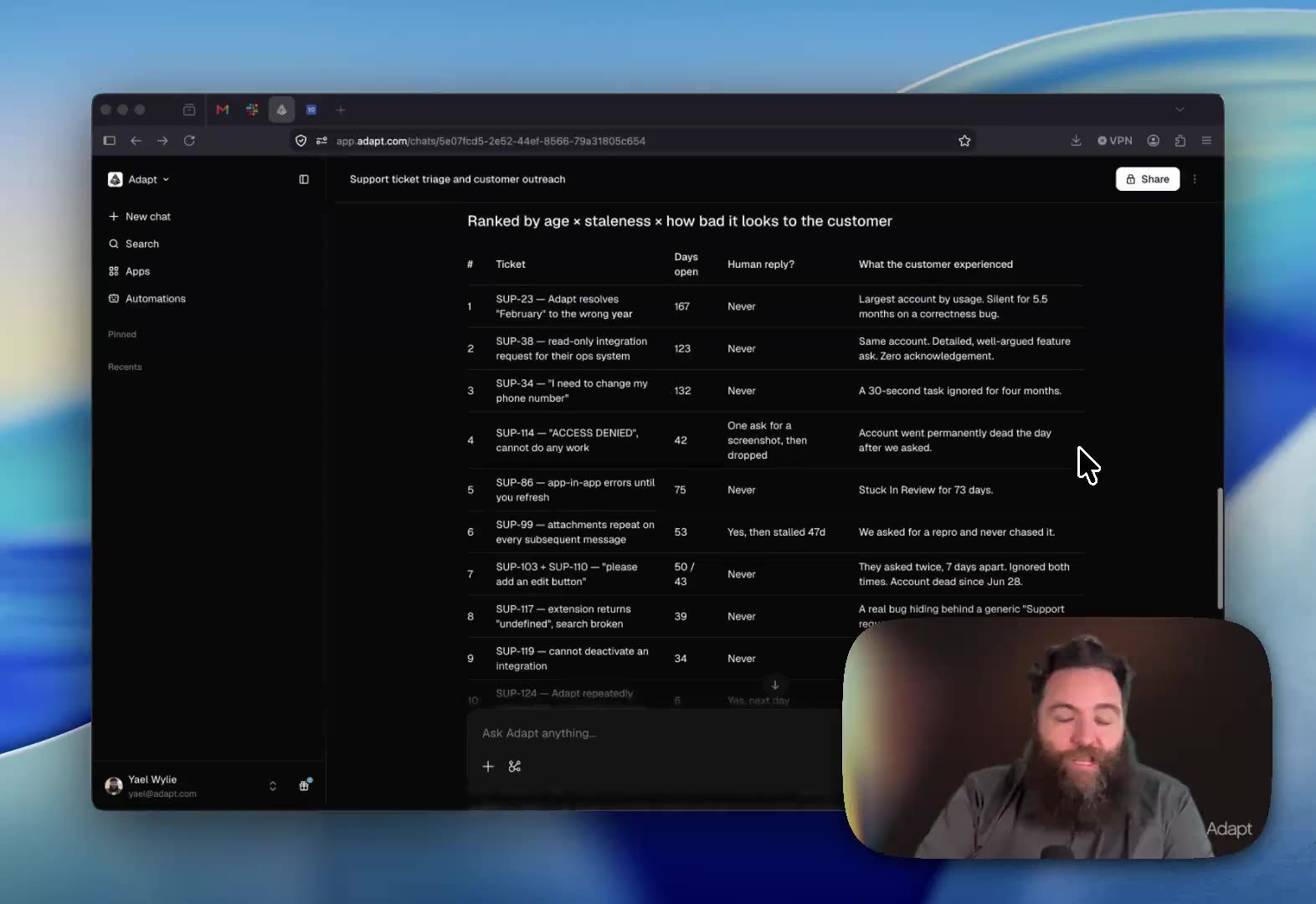
Triage a support queue and find the tickets nobody filed
Your support backlog is only half the problem. The other half is sitting in shared Slack channels as messages nobody answered. Here is how an AI coworker ranks both, and drafts the replies.

Make your company
instantly AI native.
Bring us a priority or workflow. We’ll show you how Adapt can put it to work across your company.