


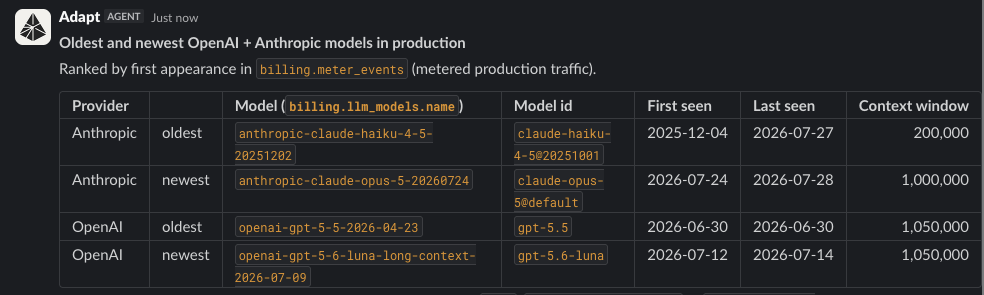
Adapt now writes a native table when a Slack answer reports several records that share the same fields. Metric grids, before-and-after values, per-item rows, and comparisons render as a real Slack table instead of a wall of dash bullets.
What changed
Slack answers previously drifted into prose or bullet lists whenever the data was tabular, which made side-by-side comparisons hard to scan. Adapt now follows one formatting contract across every Slack surface:
- Three or more records with the same fields become a table.
- One table per message. Slack rejects messages with more than one, so Adapt tables the most important set and summarizes the rest as bullets.
- Same behavior everywhere —
@Adaptmentions, direct messages, automations posting to a channel, and agent-posted messages all use the same rules.
Nothing to turn on. Ask a question with a tabular answer and you get a table.